Profit Organizations
Turn static dashboards into a dynamic governance infrastructure where strategic metrics drive accountability and continuous improvement.
For a commercial enterprise, true operational resilience is achieved when you transition from static spreadsheets and dashboards to a dynamic governance infrastructure where strategic metrics drive clear accountability and continuous improvement.
1. Mastering the Indicator Management Cycle
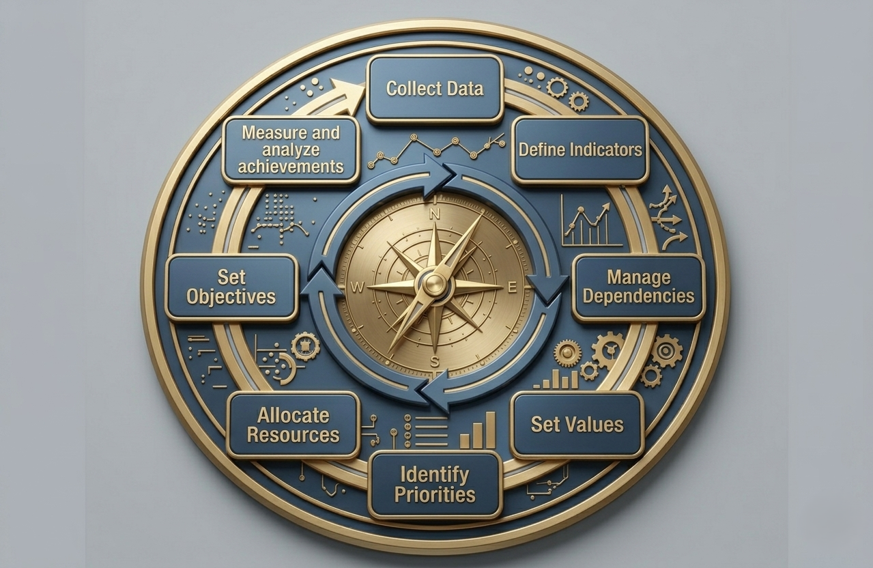
Indicator management is a rigorous process grounded in transparent, reality-based metrics, where accountability becomes a structural consequence rather than a formal policy. Indeed, this continuous improvement process aims to enhance performance and knowledge management through rationalization. It starts with collecting the indicators your organization currently uses; from there, you will decide which to keep and which to add, while managing each indicator's dependencies. Then you can connect, import, or enter the values attached to all periods and time buckets to initiate your cycle. Hence, you can identify the right priorities, allocate the most relevant resources, set meaningful objectives, and fairly measure individual and team achievements, all in one place.
2. Leveraging Advanced Operational Technology
Un8id's unique technology lets you quickly build scalable enterprise and local models, mapping complex dependencies in plain language while keeping you in absolute control. By managing the entire indicator lifecycle through interactive simulations, Un8id leverages artificial intelligence to drive deeper root-cause analysis, smart model optimization, multilingual translation, and effortless integrations. Your teams no longer waste time manually cleaning data, allowing them to instantly translate everyday operational questions into mathematically precise, transparent formulas.
3. Establishing Continuous Data Hygiene
When organizational indicators rely on a centralized data team or automated extractions from siloed systems, the context behind the numbers is often lost, leading to poor data quality. This framework resolves the issue at the source by assigning every single operational metric to a specific, named human owner within the company who is directly accountable for its validity. This decentralized approach creates a natural reflex of daily data hygiene across your entire workforce, ensuring that if a key performance indicator fluctuates, the system immediately routes it to the responsible stakeholder for validation.
4. Preserving Long-Term Institutional Knowledge
High employee turnover or sudden structural shifts often cause critical operational history, unwritten department benchmarks, and strategic continuity to vanish overnight. When you implement this framework as your core management layer, it serves as the permanent, living roadmap and governance dashboard for your business. Even as individual team members transition out of their roles, the platform retains the precise logic of your organizational metrics, ensuring an uninterrupted transfer of knowledge and a consistent, long-term grip on your company's overall health.